Backyard assembly across San Diego
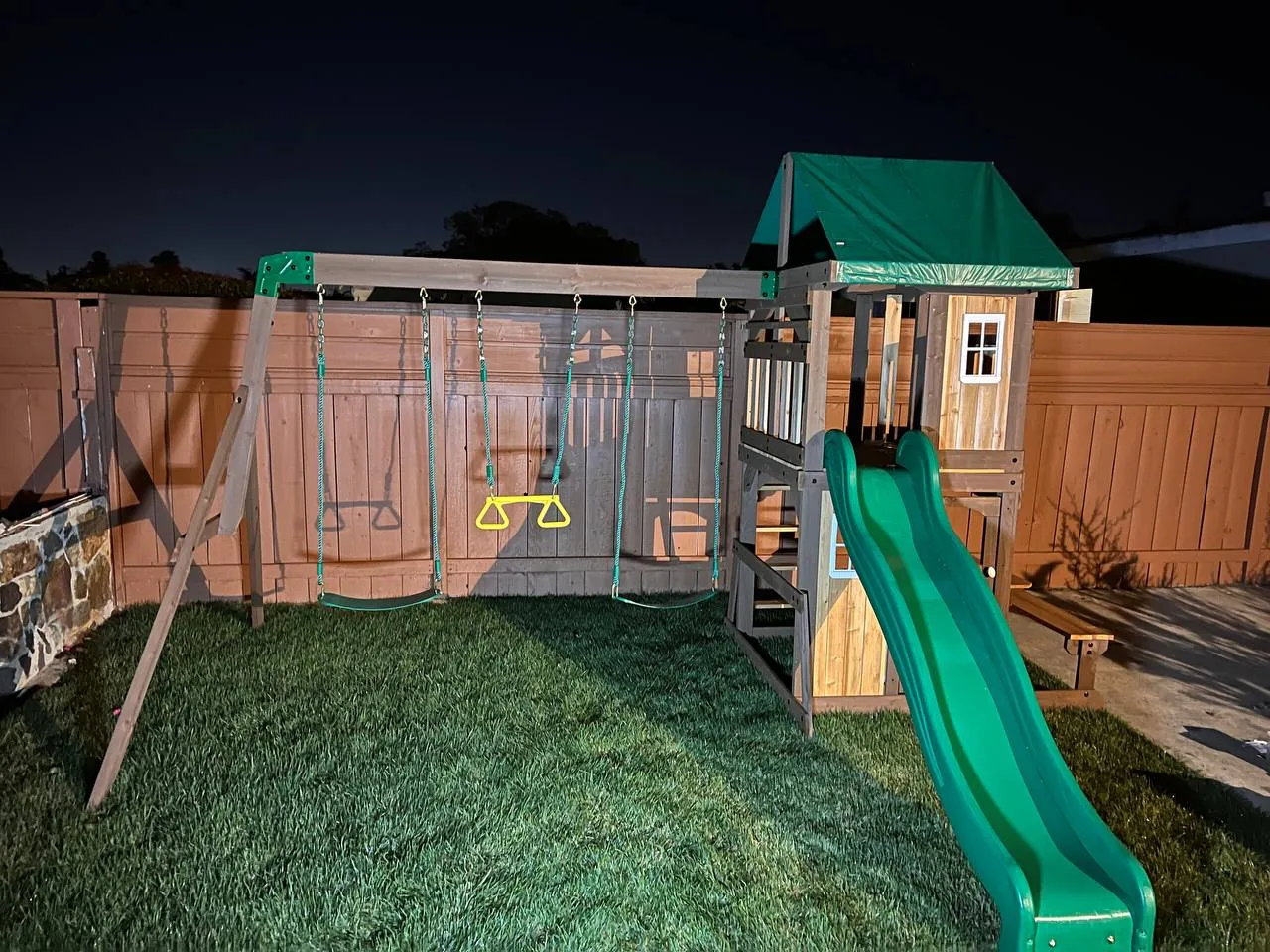
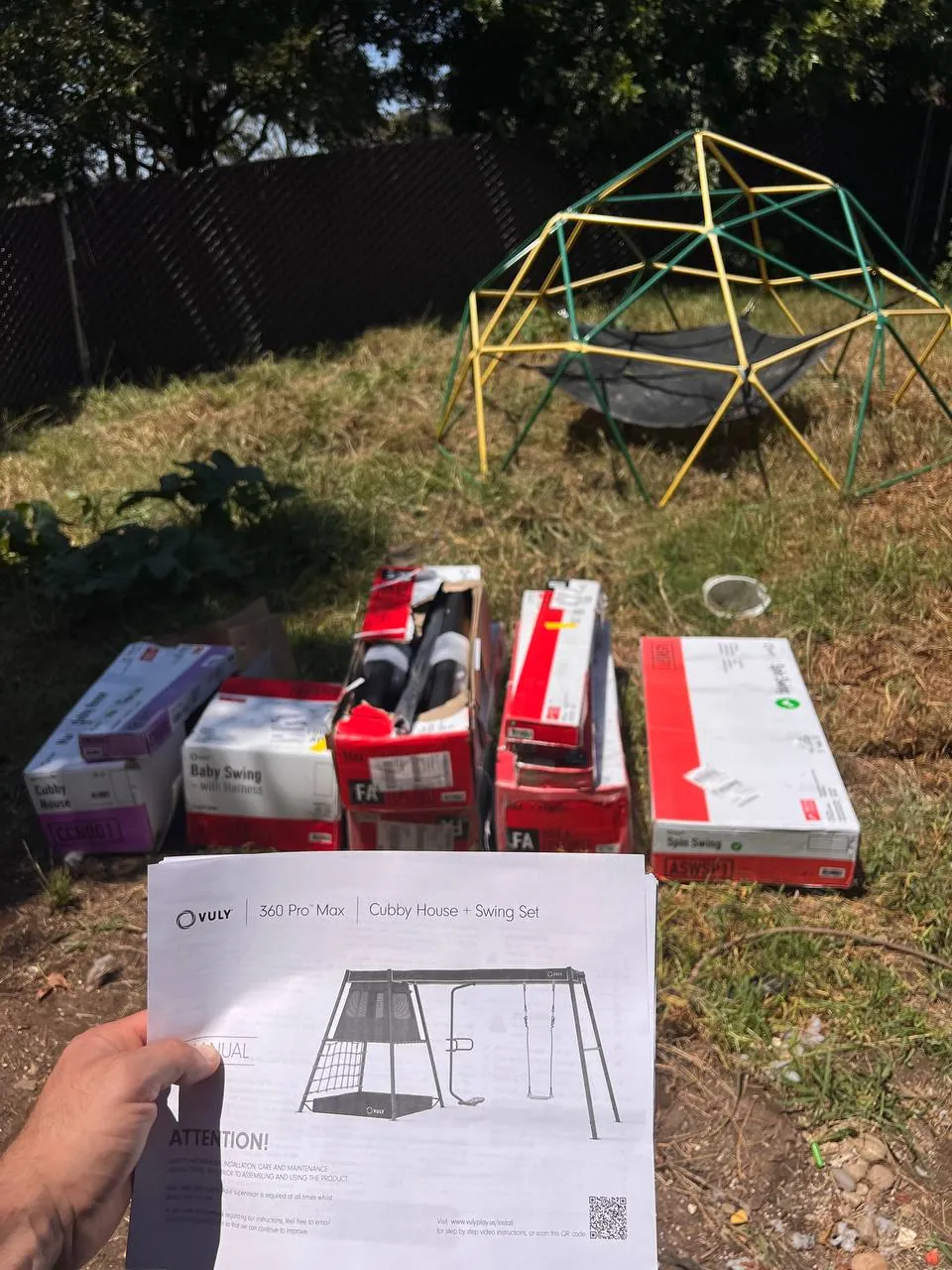
Swing sets and gazebos are the assemblies people most regret starting themselves — hundreds of parts, heavy beams, and safety that really matters because kids will be on it. Easy Break builds them by the book: every bolt torqued, the structure leveled on your yard, and anchored into the ground so it can't tip or shift. Then we haul the mountain of cardboard away.
With San Diego's year‑round backyard weather, these get used hard — so a properly built, well‑anchored structure isn't just convenience, it's safety. We build kits you've bought from Costco, Amazon, Backyard Discovery, Lifetime, Wayfair and the big‑box stores.
What we assemble
- Swing sets & wooden/metal playsets with slides, forts & climbers
- Trampolines with enclosure nets, anchored
- Gazebos, pergolas & sun shelters
- Sheds & storage kits (resin & metal)
- Outdoor & patio furniture sets
- Basketball hoops (in‑ground & portable)
Backyard assembly pricing in San Diego
Pricing depends on the kit's size and instructions, so we quote a fixed price from a photo or the product link. Typical starting points:
| Kit | What's involved | Price |
|---|---|---|
| Trampoline + net | Assemble & anchor | from $129 |
| Swing set / small playset | Build, level, ground‑anchor | from $249 |
| Large wooden playset/fort | Multi‑hour, two‑person build | from $399 |
| Gazebo / pergola kit | Assemble, level, secure | from $299 |
| Shed kit | Resin or metal, anchored | from $279 |
Big backyard box to build?
Text a photo or the product link — fixed price & a slot back fast.
Built safe & anchored to the ground
The part DIYers skip is anchoring — and it's the part that keeps a swing set from rocking or a gazebo from catching the wind. We anchor playsets, trampolines and shelters per the manufacturer's instructions and your ground type (turf, decomposed granite, concrete or pavers), so it stays put and stays safe.
We follow the anchoring and spacing guidance in the CPSC playground safety recommendations.Why San Diego chooses Easy Break
- Built strictly to spec — every fastener, no leftover parts
- Ground‑anchored for kid safety & wind
- Upfront fixed pricing from a photo or link
- All the cardboard hauled away
- Licensed, insured & 90‑day workmanship guarantee
Areas we serve
Backyard assembly throughout San Diego County, including:
Backyard assembly FAQ
How much does it cost to assemble a playset in San Diego?
Do you anchor the playset or trampoline to the ground?
Do you assemble gazebos and sheds too?
Do you supply the kit or just build it?
Realistic timelines — honest hours, two installers
Box says "4 hours assembly." Box is wrong. These are the times we actually clock, with two installers and proper tools on a level pad:
- Backyard Discovery Sterling Point — 10 hours with two installers. Solo: 14–16 hours and dangerous on the upper deck step.
- Backyard Discovery Tucson Cedar — 16 hours, two installers.
- Backyard Discovery Skyfort II — 24 hours over two days, two installers. The biggest residential kit Costco sells.
- Lifetime Adventure Tower (metal) — 8 hours, two installers. Less cedar swearing.
- Lifetime Big Stuff — 14 hours.
- Rainbow Play Systems Eagle's Nest — 2 full days; premium cedar fort kits genuinely take that long even with experienced installers.
- Rainbow Carnival — 3 days.
- Springfree trampoline compact — 4 hours; large round/oval — 6 hours.
- Yardistry 12×12 cedar gazebo — 12 hours, two installers; bigger Yardistry models scale to a day‑and‑a‑half.
If a quote promises "same day" on a Skyfort II, it's either wrong or they're skipping anchoring. We don't.
CPSC playground safety — what the standards actually require
The CPSC Public Playground Safety Handbook (Pub #325) sets the use‑zone and fall‑height standards we install to:
- Swing arc clearance — 2× the swing height from any obstacle (fence, eave, tree). A 7' swing needs 14' of clear arc front and back.
- Use zone — 6 feet of unobstructed space around the perimeter of any play equipment, in all directions.
- Impact‑attenuating surface required under decks 6' or higher: engineered wood fiber 9" deep, rubber mulch 6" deep, or a poured‑in‑place rubber surface. Grass does not meet the spec for tall decks; we tell clients this even when it's not what they want to hear.
- S‑hook spacing on swing chains — gaps in connectors must be under 0.04" to prevent finger entrapment
We measure the proposed location with these specs before we open the box; if the spot doesn't fit, we say so.
Anchoring — decoded by ground type
This is the part DIYers and budget installers skip, and it's the part that keeps the swing set from rocking and the trampoline from sailing into the neighbor's yard on a Santa Ana wind day.
- Grass over decent topsoil (most SD residential lawns) — ground anchor kit, 8 anchors minimum on a playset, driven 24" into the soil at an angle through the base rails. Standard.
- Clay soil that drains slow (Eastlake, Mira Mesa, parts of Carmel Valley) — ground anchors pull out of saturated clay after a season. We pour concrete footings (16" round × 24" deep, Quikrete 5000 crack‑resistant mix) at each post location, set a J‑bolt or post anchor in the wet concrete, then bolt the playset base to the anchor.
- Decomposed granite or wood chips — anchors won't hold in DG. We dig through to native soil and set 12" concrete plugs around each ground anchor.
- Existing concrete patio — concrete drop‑in anchors with 4‑1/2" hex bolts; we use a hammer drill with a 1/2" SDS bit to set the anchor sleeves, then bolt the base directly.
- Pavers — never anchor through a paver (you'll crack it); we lift the pavers in the anchor zone, set a footing, bed and reset the pavers around it.
Trampolines — anchoring is not optional in inland SD
Inland SD zones — Escondido, Poway, El Cajon, Ramona, Alpine — see Santa Ana wind events 40–60 mph multiple times a year. A 14' round trampoline catches the wind like a sail; unanchored ones end up in pools, on roofs, or wrapped around fences. We anchor every trampoline:
- Springfree — uses the brand‑specific in‑ground sleeve anchor system; we set 4–6 sleeves at the leg locations
- Acon, AlleyOOP, Vuly Lift 2, JumpSport — auger‑style ground anchors looped over the frame ring; 4 anchor minimum, 6 in windy zones
- Skywalker, Costco budget trampolines — universal strap kits; we add sandbags (6 × 35 lb minimum) as backup for >50 mph events
- Placement — minimum 6' clearance from fences, structures, and overhead tree branches; not under power lines
- Mat replacement — UV degrades the jump mat; expect 5–8 years for the mat and 3–5 years for the safety net regardless of brand
Gazebos — level matters more than you think
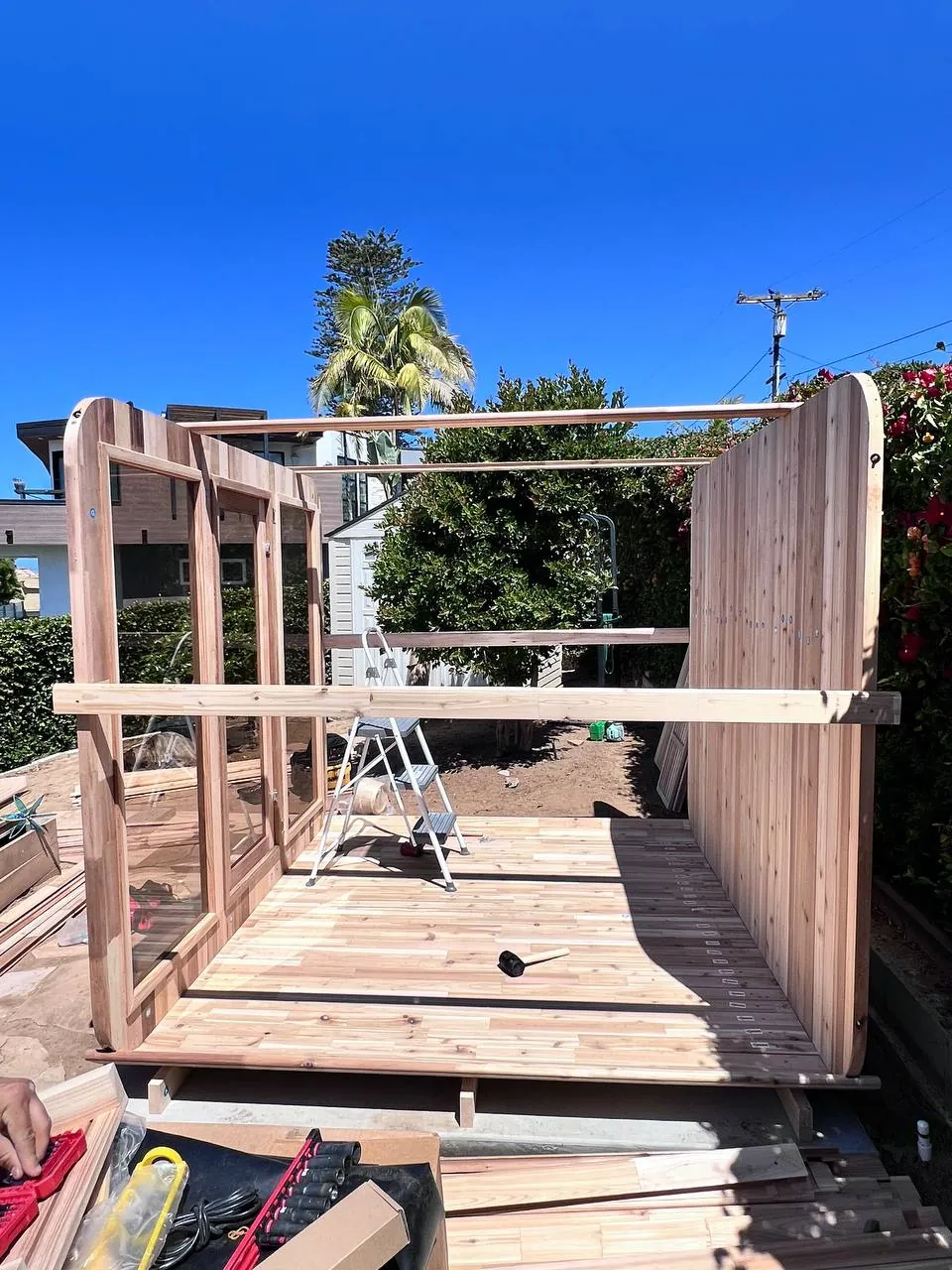
Gazebos that aren't shimmed level rack at the joints, doors won't latch, roof panels gap. Before we open the first box we shoot a laser line (Bosch GLL3‑330CG) across the four corner points; if there's more than 1" of variation across the pad we either re‑level the pad or shim every post to a string line.
- Yardistry cedar gazebos (10×12, 12×12, 12×14) — sold at Costco; pre‑stained from the factory but expect to re‑apply sealer at year 2 and every 2 years after; wood movement loosens joinery — we re‑torque all bolts at year 1
- Sojag Mykonos / Genova — aluminum frame, polycarbonate or steel hardtop; zero maintenance, lighter assembly, less character
- Sunjoy Riplie series — steel frame with metal roof; gives a pavilion look at gazebo pricing
- Permanent anchoring — 4 concrete corner footings (16" × 24" Quikrete 5000); semi‑permanent over an existing deck = lag bolts through the deck into the joists below (locate joists first)
Basketball hoops — in‑ground vs portable, honest take
If you own the house, install in‑ground; if you rent or might move in 2 years, portable. The numbers:
- Goalrilla GS‑I (or GS‑III, GS‑54) — in‑ground; requires a 5'×3'×4' deep concrete footing (about 14 bags of Quikrete 5000); 36–72 hour cure before any backboard load. Premium feel, indistinguishable from a school hoop.
- Pro Dunk Hoops — even larger in‑ground, premium custom; usually a 2‑day install with cure between days.
- Spalding 60‑NBA portable — base fills with sand or water. Sand is denser: 35 gallons of sand = ~450 lb (vs 280 lb for water). Sand wins. Also doesn't freeze (not an SD issue but matters for long‑term).
- Lifetime Mammoth portable — budget pick, fine for occasional driveway play, expect to replace the backboard in 5 years from UV.
Pre‑assembly checklist — what you should do before we arrive
- Inventory the parts against the ship manifest as soon as the kit arrives. Backyard Discovery and Costco kits commonly ship missing 1–2 hardware bags; reporting it early gets replacements in 5–7 days rather than 2 weeks.
- Have the pad ready — the area we're building on needs to be cleared, mowed and reasonably level. We can fine‑level; we don't grade.
- Clear access for the largest beam (some playset top beams are 12' long; check your side gate width)
- Power within extension‑cord range; we bring our own tools but we plug into your outlet
- Decide on stain — Backyard Discovery cedar comes pre‑stained but most premium kits ship unstained; if you want a finish on it, we apply after assembly
Edge cases
- Sloped backyards — we level with concrete piers on the high side and treated 4×4 cripple posts to bring the playset to plumb; this adds about 4 hours to most builds
- HOA approval — many SD HOAs (Carmel Valley, Eastlake, 4S Ranch, Del Sur) require a written placement plan with screening before any playset goes up; submit before you buy
- Footings cure time — if we pour concrete footings we schedule the playset install for the following day; rain delays this
- Shipping damage — Backyard Discovery and Costco both swap damaged parts free, but it adds 5–7 days; we'll stage the build around the missing piece if it's not structural
What we don't do
We don't modify or customize kits — drilling new holes, adding non‑manufacturer accessories, or substituting hardware voids the warranty and the structural rating. We don't install used playsets unless every original bolt, bracket and chain is present (mismatched hardware = unsafe). We don't install in‑ground pool basketball hoops (engineered for diving safety, separate trade). And we don't assemble above‑ground pools or spas — those need a pool sub for the plumbing, electrical bonding and water chemistry.